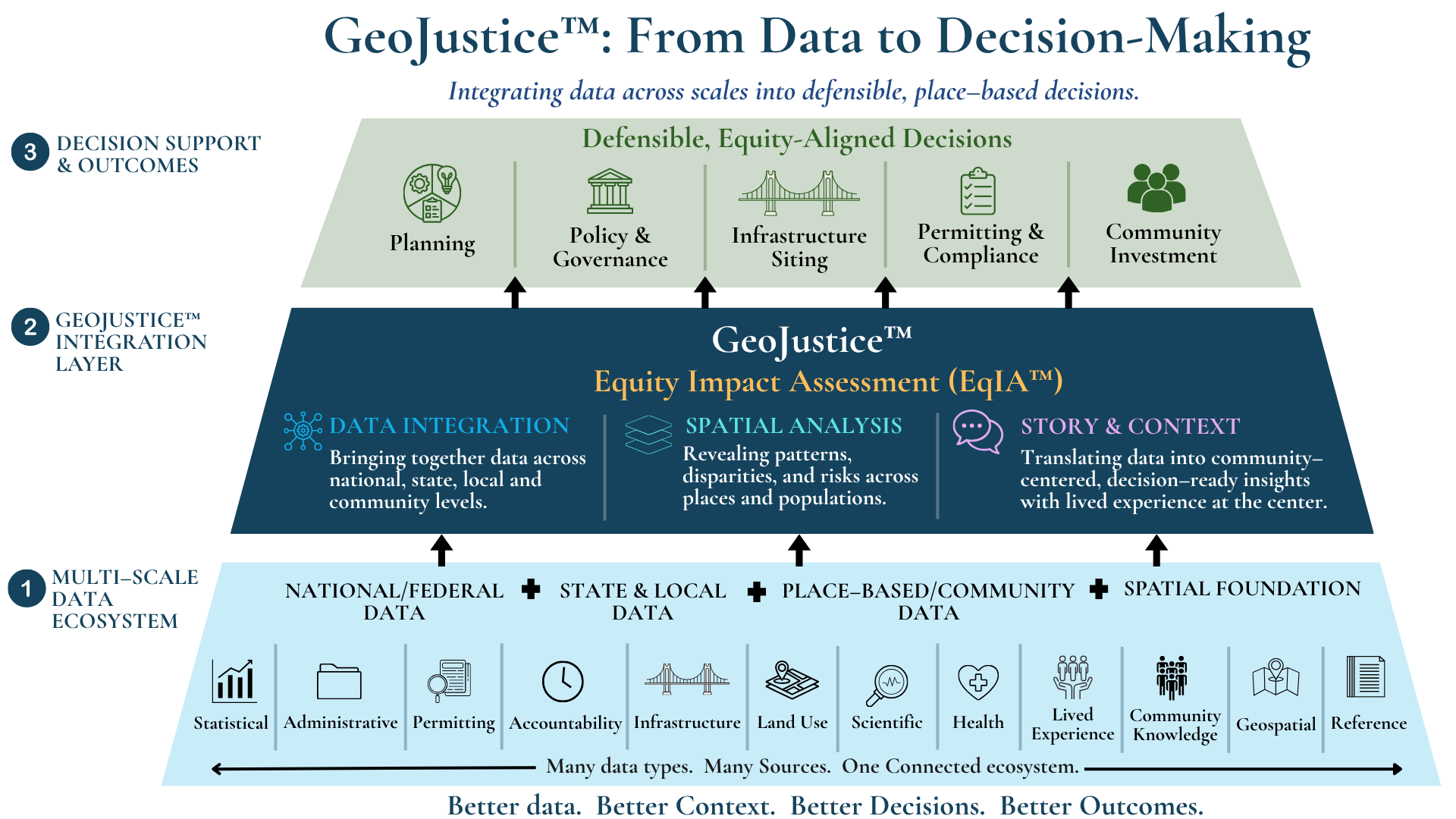
From Analysis to Action
GeoJustice™ works at the intersection of:
Cumulative Impact Analysis
Community Benefit Design
Environmental Justice
Infrastructure Planning
Redevelopment Strategy
Climate Resilience
Implementation Readiness
Strategic Decision Support
Whether supporting a municipality, nonprofit, redevelopment authority, public agency, or project team, our focus remains the same:
Helping organizations move from data to decision-making.
Selected Work
Recent GeoJustice™ work has explored topics including cumulative impacts associated with data center development, community benefit strategies, redevelopment planning, lead resource prioritization, and implementation readiness.
Truth Brokers Through Data™
Leadership
GeoJustice™ is led by Matthew T. Lee, an environmental justice and geospatial policy professional with nearly two decades of experience at the intersection of federal policy, applied mapping, and data-driven decision-making.
Matthew spent over 17 years at the U.S. Environmental Protection Agency, where he helped lead the development and application of environmental justice screening and mapping tools and trained more than 10,000 stakeholders across government and non-governmental organizations.
His experience also includes advising industry on the application of environmental justice data in operational and siting decisions, including work supporting the integration of EJScreen into analyses of transportation and facility impacts.
In addition, Matthew has contributed to emerging industry standards at the intersection of climate, environmental justice, and data-driven analysis through ASTM International, helping shape how organizations evaluate environmental and community impacts.
He currently serves as a Lecturer in the Master of Environmental Studies program at the University of Pennsylvania and as Compliance Officer for a $50+ million EPA-funded grant portfolio supporting more than 200 community-driven environmental and public health projects.
His work is grounded in the belief that data can serve as a tool for equity—when it is made accessible, transparent, and actionable.